
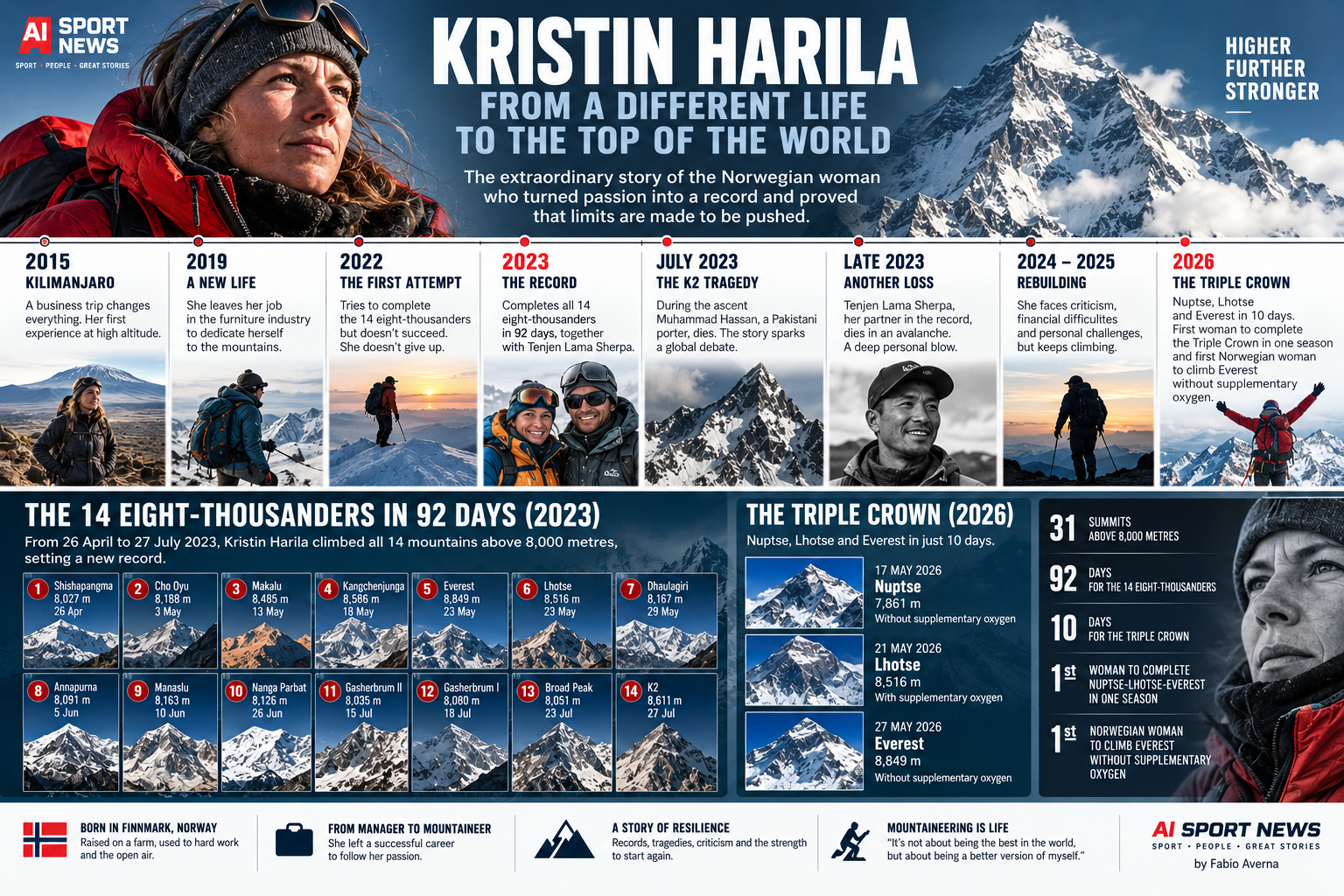
Some people spend an entire lifetime trying to discover their limits. Kristin Harila chose to search for hers in a place where a single mistake can be fatal: above 8,000 metres, where there is so little oxygen that the human body slowly begins to shut down.
Her story, however, does not begin on Everest, nor among the ice and rock of K2.
It begins much farther north, in Norway’s Finnmark region.
Harila grew up near Vadsø, on a farm, in an environment where hard work became part of everyday life from an early age. As a child, she was already accustomed to responsibility, sport and the outdoors.
Before the mountains, there was skiing.
Cross-country skiing and running helped build what would later become one of the fundamental tools of her mountaineering career: an extraordinary ability to endure fatigue.
But for many years, mountaineering was not her profession.
Harila pursued a completely different career, eventually taking on major managerial responsibilities in the Norwegian furniture industry. From the outside, her life appeared to be already mapped out.
Then, in 2015, came Kilimanjaro.
A trip took her to Africa’s highest mountain. It was her first real encounter with altitude, and something changed.
Holidays gradually became opportunities to climb. The mountains grew higher, the challenges became harder, and with every expedition came the feeling that the professional life she had built was no longer the life she wanted.
In 2019, she made the decision that would change everything.
She left her job.
She was already in her thirties and did not have the decades-long mountaineering background of many elite climbers. Yet she decided to try to turn her passion into her life.
Four years later, she would become part of one of the most extraordinary records in modern high-altitude mountaineering.
Fourteen Mountains Above 8,000 Metres
Everest, K2, Kangchenjunga, Lhotse, Makalu, Cho Oyu, Dhaulagiri, Manaslu, Nanga Parbat, Annapurna, Gasherbrum I, Broad Peak, Gasherbrum II and Shishapangma.
They are the fourteen mountains on Earth rising above 8,000 metres.
In 2019, Nirmal “Nims” Purja had completed all fourteen in 189 days.
Harila believed it could be done faster.
She made her first major attempt in 2022 but was unable to complete the project.
Instead of abandoning the idea, she returned the following year.
The clock started on 26 April 2023, on Shishapangma.
Alongside her was a man who would become fundamental to the story: Tenjen “Lama” Sherpa.
What followed was an extraordinary race through the Himalayas and Karakoram.
Cho Oyu came on 3 May.
Makalu on 13 May.
Kangchenjunga on 18 May.
On 23 May, something even more remarkable happened: Everest and Lhotse were climbed on the same day.
Dhaulagiri followed on 29 May, Annapurna on 5 June and Manaslu on 10 June.
At the end of June came Nanga Parbat.
July brought the final phase: Gasherbrum II on 15 July, Gasherbrum I on 18 July and Broad Peak on 23 July.
Only one mountain remained.
K2.
At 8,611 metres, K2 is not merely the second-highest mountain on Earth. It is one of mountaineering’s ultimate symbols: steep, technical, unpredictable and unforgiving.
On 27 July 2023, Harila and Tenjen reached the summit.
Only 92 days had passed.
The previous benchmark of 189 days had effectively been cut in half.
It should have been the perfect ending.
Instead, that day would forever change the meaning of their achievement.
Tragedy in the Bottleneck
During the same ascent of K2, Pakistani high-altitude porter Muhammad Hassan, a 27-year-old father of three, suffered a fatal accident in the Bottleneck, one of the mountain’s most dangerous sections.
What happened subsequently generated international controversy.
Images from the mountain showed climbers moving through the area while Hassan was in critical condition. Serious questions followed. Critics asked whether the drive to reach the summit and complete the record had taken priority over an attempt to save a human life.
Harila rejected that interpretation.
According to her account, when her group reached Hassan in the darkness, he was hanging below the route and his harness had slipped down towards his knees. Members of the team tried to help him, spending considerable time attempting to reposition him. Her cameraman, Gabriel Tarso, remained in the area trying to assist.
Hassan died on the mountain.
The images triggered a debate far larger than Harila herself.
Who does the dangerous work that allows foreign climbers to reach the world’s highest summits? What equipment, training and protection are provided to high-altitude workers? And how much is a record worth when someone is dying nearby?
Harila became one of the central figures in that debate.
The triumph of the 92-day record could no longer be separated from the tragedy on K2.
Another Loss
But 2023 had another devastating chapter still to come.
Tenjen Lama Sherpa had not simply accompanied Harila.
He had climbed all fourteen eight-thousanders alongside her and shared the 92-day achievement.
Only months after K2, Tenjen was killed in an avalanche during another Himalayan expedition.
He left behind two children.
Harila later supported efforts connected to their education, remembering Tenjen not simply as an elite climber but as a friend and partner with whom she had shared one of the greatest adventures of her life.
The mountains had given Harila worldwide fame.
They had also shown her their terrible price.
The aftermath of the record brought further challenges. Public criticism, financial pressure and the enormous emotional consequences of everything that had happened forced her to confront a completely different kind of endurance.
She had climbed fourteen of the world’s highest mountains.
Now she had to rebuild at sea level.
Yet She Returned
This is where Kristin Harila’s story enters another dimension.
In 2026, she returned to the Himalayas with a very different project.
Not fourteen mountains in a race against the clock, but three giants surrounding Everest:
Nuptse, Lhotse and Everest.
The Triple Crown.
The expedition began in the spring.
As always, however, the mountain dictated the schedule. Conditions in the Khumbu Icefall affected the early stages of the expedition, forcing Harila to adapt her acclimatisation programme.
There were rotations higher on Everest: Camp 2, Camp 3, back to Base Camp, recovery and then another climb.
This was no longer simply about strength.
It was about managing the body, energy, altitude, weather and risk.
Three Mountains in Ten Days
On 17 May 2026, Harila reached the 7,861-metre summit of Nuptse, without supplementary oxygen.
Nuptse may be lower than the neighbouring eight-thousanders, but it is a serious technical mountain, with steep terrain, exposure and a demanding summit ridge.
Harila had wanted to climb it for years.
Four days later, she was already back at extreme altitude.
On 21 May, she reached the 8,516-metre summit of Lhotse, the fourth-highest mountain in the world.
Conditions near the top were difficult, with strong winds. Harila chose to use supplementary oxygen for safety.
It was another extraordinary milestone in a career that, just over a decade earlier, had barely begun.
But one mountain remained.
Everest.
8,849 Metres Without Supplementary Oxygen
After Lhotse, Harila returned to Base Camp.
She rested.
Then she went back up.
Camp 3.
Camp 4.
The wind made recovery difficult.
Shortly before nine in the evening, the final summit push began.
And somewhere high above the South Col, the challenge stopped being about statistics.
Harila was exhausted.
During the climb towards the Balcony, she seriously considered using supplementary oxygen. She was struggling with an overwhelming desire to sleep.
At almost 8,000 metres, falling asleep is not a trivial matter.
It can become extremely dangerous.
Harila later described stopping, drinking some Coca-Cola, taking an energy gel and deciding to continue.
One step.
Then another.
Through the darkness.
Higher and higher.
Until the morning of 27 May 2026.
At 8,849 metres, Kristin Harila reached the summit of Mount Everest without supplementary oxygen.
Nuptse on 17 May.
Lhotse on 21 May.
Everest on 27 May.
Three mountains in ten days.
According to her team, the achievement made Harila the first woman to complete Nuptse, Lhotse and Everest in the same season, as well as the first Norwegian woman to summit Everest without supplementary oxygen.
More Than Thirty Eight-Thousander Summits
By the age of forty, Harila had reached a point that would have seemed almost impossible when she first encountered high altitude on Kilimanjaro in 2015.
In only a few years at the highest level of mountaineering, she accumulated more than thirty ascents of peaks above 8,000 metres.
But perhaps the most extraordinary number is not the number of summits.
It is the time.
In 2015, she was a manager discovering high-altitude climbing.
In 2019, she left her job.
In 2023, she completed all fourteen eight-thousanders in 92 days.
In 2026, she stood on Everest without bottled oxygen.
An extraordinary transformation in little more than a decade.
What Does It Really Mean to Conquer a Mountain?
It is easy to tell Kristin Harila’s story through numbers.
92 days.
14 eight-thousanders.
8,849 metres.
More than 30 eight-thousander summits.
But perhaps the most important part of her story begins when we stop looking at the numbers.
Harila has experienced both faces of extreme mountaineering.
There is the one we see in summit photographs: flags in the wind, endless skies, smiles, records and triumph.
Then there is the part that often remains outside the frame: fear, money, logistics, the crucial work of Sherpas and other high-altitude workers, decisions made when the brain is deprived of oxygen, accidents and people who never return from the mountain.
The events on K2 in 2023 will inevitably remain part of Harila’s story.
It would be wrong to erase Muhammad Hassan’s death from the story of the record.
It would be equally wrong to present every accusation made against Harila as an established fact.
That uncomfortable territory is precisely what makes her story bigger than a simple sporting achievement.
Because it forces us to ask a difficult question:
Is there a point at which the pursuit of the limit must stop?
Perhaps Kristin Harila has spent years searching for that answer on the highest mountains on Earth.
And perhaps the mountains have taught her something else.
A mountain is never truly conquered.
Sometimes, it simply allows you to reach the summit.
Then you still have to make it home.
Fabio Averna