

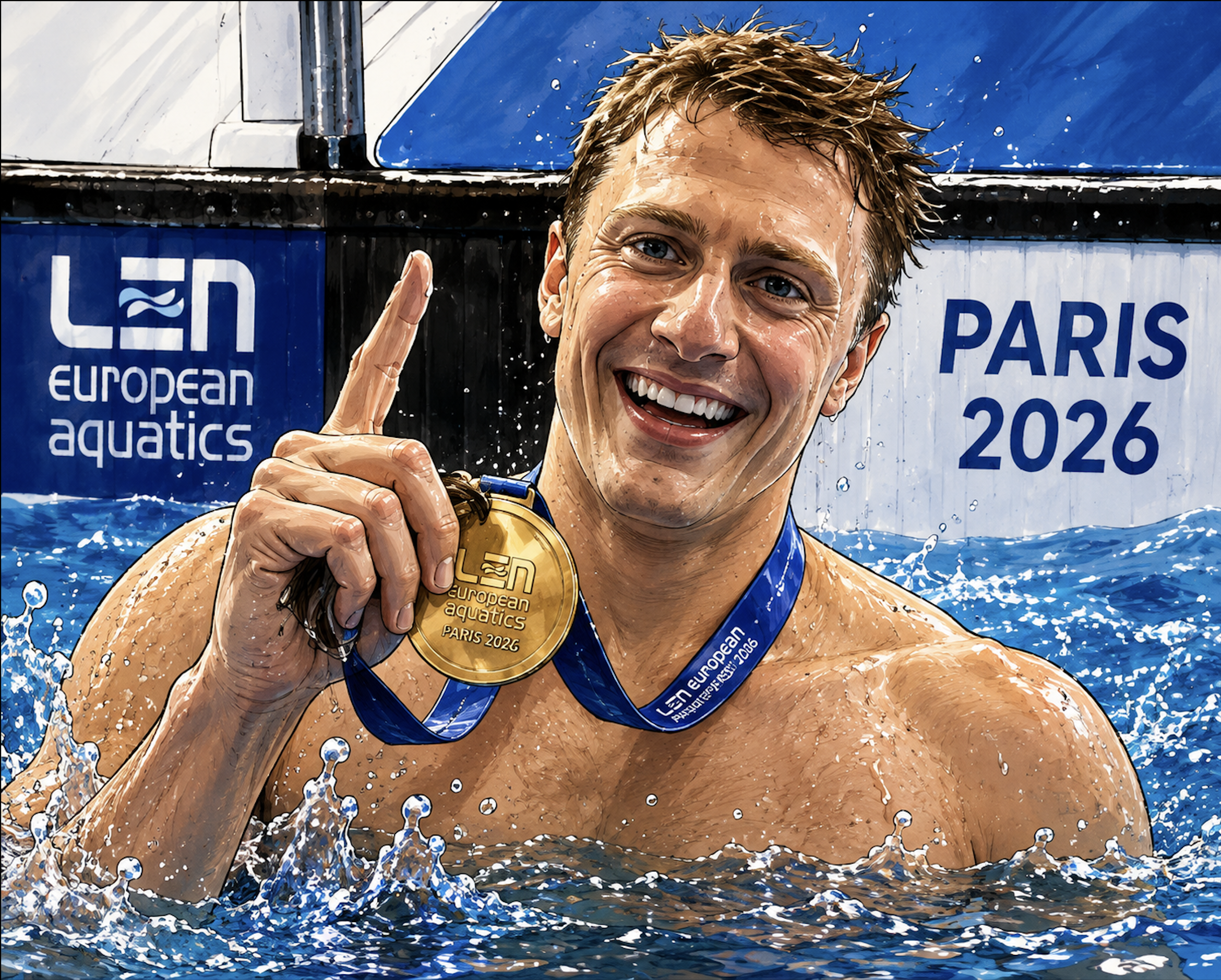
Five hundredths of a second. That was all that separated a great race from a European gold medal. Nicolò Martinenghi found those precious hundredths when they mattered most, turning an incredibly tight final into another golden chapter of his career.
At the 2026 European Swimming Championships in Paris, the Italian champion claimed the 50m breaststroke title, stopping the clock at 26.57.
Right behind him came another Italian, Simone Cerasuolo, who touched the wall in 26.62, sharing the silver medal with the Netherlands’ Koen de Groot, who recorded exactly the same time.
But the stopwatch tells only part of the story.
The 50m breaststroke leaves no room for hesitation. There is no time to study your rivals, change tactics halfway through the race or recover from a mistake. Everything has to work immediately: reaction time, power, stroke rate, technique and, finally, the touch at the wall.
Martinenghi put all those pieces together.
From the start, the final became a battle measured not in metres but in centimetres. Nobody managed to break away, and as the swimmers approached the wall, the race remained almost impossible to call.
Then came the decisive moment.
26.57. Gold.
Martinenghi looked towards the scoreboard and received the confirmation he was waiting for: once again, his name was at the top.
The victory carries even greater significance because it follows his triumph in the 100m breaststroke. Paris therefore becomes the stage for a remarkable individual double, with Martinenghi proving that he can dominate both the Olympic distance and the explosive one-length sprint.
And this time, Italy had twice as much reason to celebrate.
Cerasuolo finished just five hundredths behind his teammate. Two Italians occupying the leading positions in a European final is more than a collection of medals: it is a powerful image of the extraordinary level reached by Italian breaststroke swimming.
For Martinenghi, however, this gold medal also tells a more personal story.
The swimmer from Varese continues to find ways to remain among the very best. Seasons change, rivals change and distances change, but when the biggest finals arrive, Martinenghi continues to deliver.
In Paris, he needed little more than 26 seconds.
And above all, five hundredths.
Five hundredths that turned another European final into another golden night for Nicolò Martinenghi.
Fabio Averna
