
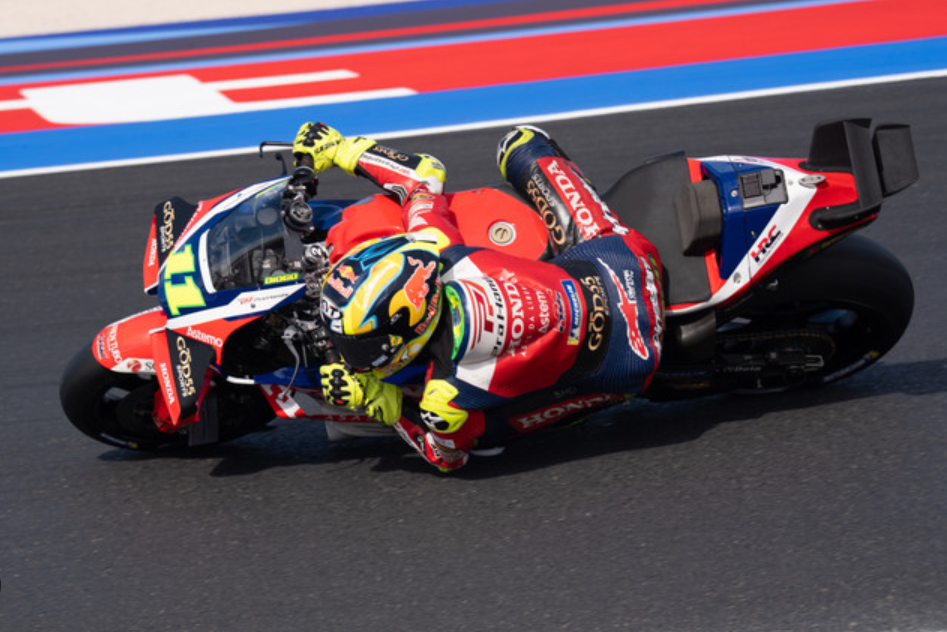
The future of MotoGP has started to show its real potential at the Red Bull Ring. During the test day dedicated to the development of the new Pirelli tyres and the 850cc prototypes set to debut under the 2027 technical regulations, Diogo Moreira produced the biggest surprise by putting the Honda RC214V at the top of the timesheets with a 1’28”4 lap.
It was a particularly significant benchmark because it was achieved on a motorcycle that is still under development and is already remarkably close to the performance of the current 1000cc MotoGP machines.
The Brazilian LCR Honda rider used the soft rear Pirelli tyre to set a lap that put him only around half a second away from the pole position time recorded by Jorge Martin during the Austrian Grand Prix weekend.
It was a result that highlighted not only Moreira’s speed, but also the progress Honda has made with the project that will lead the Japanese manufacturer into MotoGP’s new technical era.
Pedro Acosta confirmed his speed just behind him. The KTM rider took the new 850cc RC16 to a time of around 1’28”8, completing an extremely positive day for the Austrian manufacturer.
Acosta continues to establish himself as one of the key references in the development of the new generation of MotoGP prototypes, with the 850cc machine already capable of producing highly competitive lap times despite still being in the early stages of its development.
Honda also left Spielberg with further encouraging indications thanks to Johann Zarco. The Frenchman put another RC214V 850cc near the top of the standings with a lap around the 1’29”0 mark, suggesting that Moreira’s performance was not simply an isolated result.
Aprilia’s work was equally interesting. Marco Bezzecchi recorded a 1’29”1 while using the hard rear Pirelli tyre.
That figure becomes even more impressive considering that the Italian rider did not benefit from the extra performance offered by the softer compound used by some of the riders ahead of him.
Bezzecchi’s performance confirmed that the new 850cc bikes are already capable of producing very competitive lap times even without using the most performance-oriented tyre option.
Ducati continued its development programme with Fermín Aldeguer, Franco Morbidelli and Marc Marquez.
Rather than focusing exclusively on a single fast lap, the Borgo Panigale manufacturer used the test to collect important information about the different Pirelli compounds and the behaviour of the new 850cc Desmosedici.
Marquez mainly completed short runs, working on race pace and adapting to the characteristics of the future MotoGP machine.
The Austrian test was also an important moment for Maverick Viñales.
The Spaniard returned to the track after his left shoulder problem and rode both a modified 1000cc KTM and the new 850cc prototype.
With the 1000cc bike adapted to the Pirelli tyres, Viñales recorded a 1’29”2, while on the 850cc prototype he managed to break the 1’30” barrier.
The physical feedback was positive, with Viñales now targeting a return at the Japanese Grand Prix.
A total of 18 riders took part in the test.
Thirteen used the new 850cc prototypes, while several others rode modified versions of the current 1000cc machines, without ride-height devices, with reduced aerodynamics and adapted to the new Pirelli tyres.
This configuration gave engineers the opportunity to gather valuable comparative data and understand how much of the performance comes from the new tyres and how much is linked directly to the characteristics of the future MotoGP bikes.
That comparison is perhaps the most important conclusion to emerge from the Red Bull Ring.
Despite the reduction in engine capacity from 1000cc to 850cc, the removal of ride-height devices and more restrictive aerodynamic regulations, the new MotoGP bikes are already capable of getting extremely close to the lap times of the current machines.
Pirelli appears to be playing a major role in this process.
The level of grip offered by the new tyres allows the riders to recover a significant part of the performance that would theoretically be lost through lower engine capacity, reduced power and more limited aerodynamics.
The possibility — or perhaps the promise for MotoGP fans — is that after several more months of development, the new 850cc machines could become extremely fast over a single lap despite potentially having lower top speeds than the current 1000cc bikes.
Yamaha, meanwhile, continues to work with the objective of reducing the gap to the fastest manufacturers.
Toprak Razgatlioglu continued adapting to the new 850cc M1 alongside Jack Miller and Augusto Fernandez, while Izan Guevara worked on the modified 1000cc version as part of his preparation for his future step into the premier class.
The next testing sessions will be equally important.
The test riders are expected to continue development work with Pirelli at Jerez on October 7 and 8, while Honda will continue its programme at Sepang on October 14 and 15.
For many of the factory riders, however, one of the most significant moments will arrive on December 1 in Valencia, when MotoGP will move further into its preparations for the 2027 season.
The Red Bull Ring test therefore leaves one message above all others: the technical revolution of 2027 does not appear set to dramatically slow MotoGP down.
On the contrary, the first lap times suggest that the performance level of the new 850cc machines could quickly approach that of the current 1000cc bikes.
And in Austria, the first name written at the top of MotoGP’s new era was Diogo Moreira.
Fabio Averna