
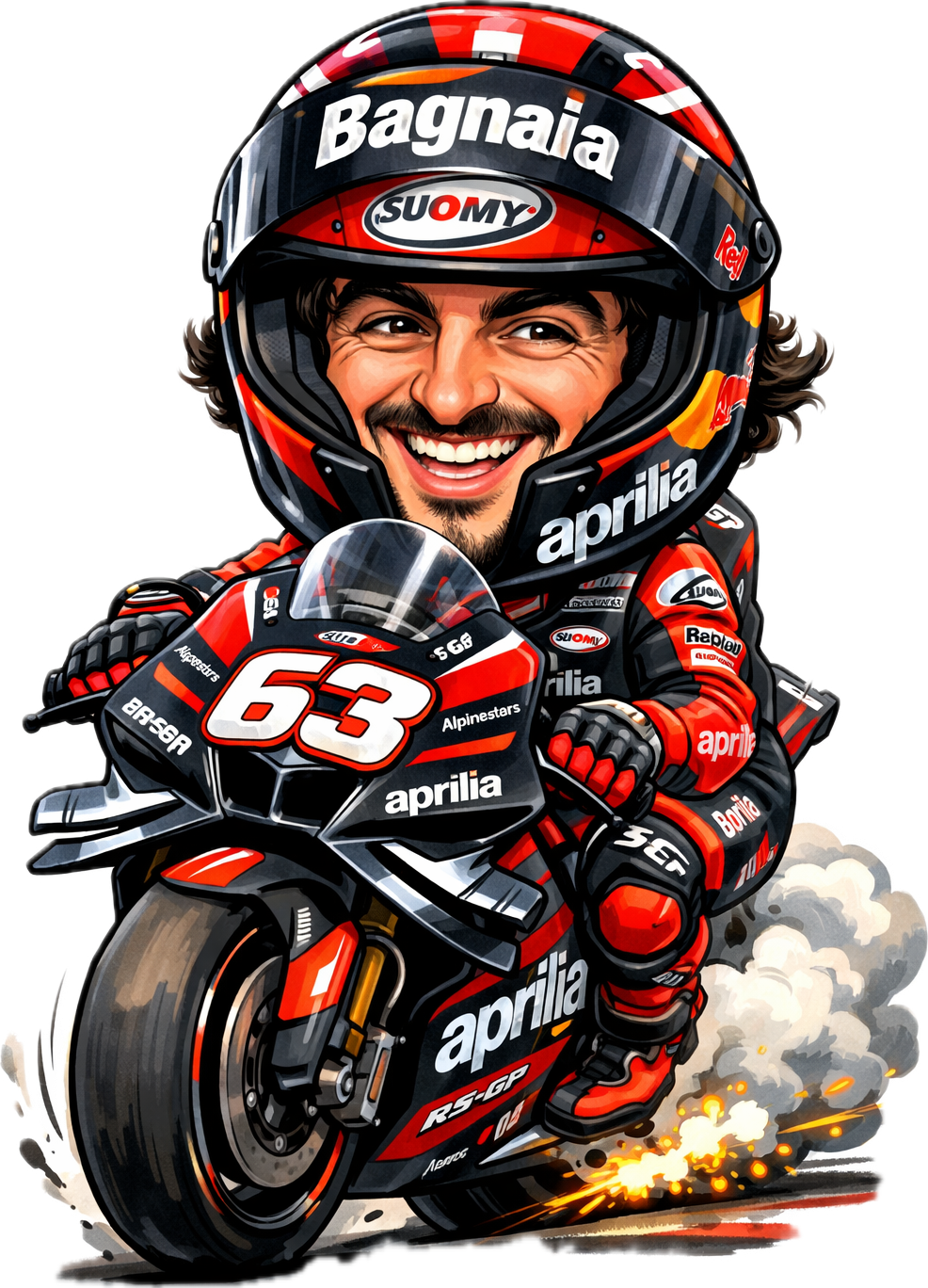
The arrival of Francesco Bagnaia at Aprilia Racing from 2027 represents one of the most significant moves in modern MotoGP, not only because of the calibre of the rider involved but also for the technical and strategic implications this decision brings. After closing an extraordinary chapter with Ducati Lenovo Team, Bagnaia identified Aprilia as the project that offers him the greatest centrality, room for personal growth and a motorcycle more adaptable to his riding style.
Aprilia comes from years of steady development, during which it has progressed from being considered an outsider to establishing itself as one of the most balanced prototypes on the grid. The RS-GP has shown a neutral, stable and highly communicative chassis—qualities that are fundamental for a rider who builds his speed on front-end sensitivity. Bagnaia is a precise interpreter: he likes deep braking, smooth corner entry and full control of the bike on initial lean. Aprilia, by nature, is a machine that enhances exactly this type of riding—clean rather than aggressive, focused more on trajectory precision than brute force.
Another decisive aspect concerns engine management. The Noale V4 does not have the explosive power of the Desmosedici, but it offers a more linear and consistent delivery. This translates into better tyre management, less stress on the rear end and more regular race pace. For a rider like Bagnaia, who wins by building advantages over rhythm rather than occasional fast laps, this characteristic can become a significant strength. Aerodynamically, Aprilia also arrives at this point with solid foundations: it was among the first to push extreme solutions such as side winglets, integrated swingarm wings and advanced anti-wheelie packages. With the arrival of a world champion capable of providing high-level feedback, these areas can evolve even faster.
Bagnaia’s choice is not only technical but also structural. At Aprilia he will find a role of absolute reference, something that Ducati could no longer fully guarantee given the rise of other internal talents and the arrival of the new generation. In Noale, however, the entire 2027–2029 development cycle can be shaped directly around his feedback—just as it happened in the past when a rider was truly “the man of the project.” A more familiar environment, a more compact structure and the opportunity to directly influence engineering decisions are all factors that led Bagnaia to say yes.
His arrival, however, has a much wider impact than a simple change of colours. The move triggered a real domino effect in the rider market: Ducati accelerated its rejuvenation strategy, Yamaha reorganised its technical revolution linked to the new V4, Honda reshaped its technical structure by adding European figures, while KTM remains aggressive in development but loses the chance to secure an already proven champion. The 2027 grid risks looking completely different from the one seen at the beginning of the decade, with new technical geographies and new balances among the manufacturers.
There are challenges ahead as well. Despite Aprilia’s improvements, it still lacks the industrial strength and reaction speed of Ducati. There will be moments when development will require patience, shared decisions and longer timelines. Bagnaia will need to adapt to an environment that demands much from its riders in terms of project involvement. At the same time, he will be the figure guiding aerodynamic, ergonomic, electronic and chassis-related decisions—a fascinating but complex task.
His choice, however, follows a clear logic: leaving a perfect motorcycle for one that can become perfect thanks to him. It is a decision that speaks of leadership, maturity and courage. If the collaboration works and the RS-GP grows as expected, Bagnaia could become the man who brings Aprilia to its first-ever MotoGP world title.
A risky challenge with enormous potential. A move that doesn’t just change a career—but the direction of an entire category.
Fabio Averna